

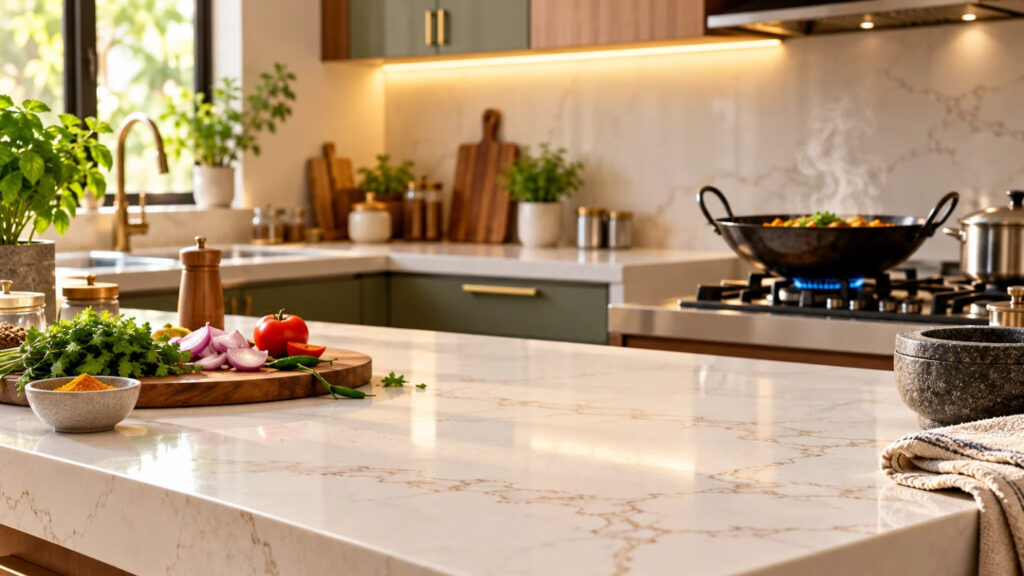
What Matters Most
- Easy to maintain. Engineered quartz resists many everyday stains and usually needs no sealing.
- Heat needs care. Always use trivets for hot cookware, especially tawas, kadais, and pressure cookers.
- Quality matters most. Compare specifications, installation, warranty, and total cost before buying.
Indian kitchens work hard. From morning tea and breakfast to pressure cooking, frying, kneading dough, and preparing family meals, kitchen countertops face frequent spills, splashes, and cleaning.
Choosing the right surface matters because appearance is only one part of the decision. A good countertop should suit how you cook, fit your budget, and remain manageable over years of everyday use.
Engineered quartz, including products manufactured in India, has become an option for homeowners looking for a clean, contemporary kitchen with relatively little maintenance. But is it better than traditional granite or other countertop materials?
Here’s what to consider before choosing it.
What Is Indian Quartz?
Indian quartz generally refers to engineered quartz surfaces manufactured in India. Unlike natural granite or marble, engineered quartz is a manufactured material made by combining crushed minerals, typically including quartz, with resins, pigments, and other ingredients.
The result is a finished slab designed for uses such as kitchen countertops, bathroom vanities, and other interior surfaces.
Engineered quartz is different from natural quartzite, which is a stone quarried from the earth. Although their names sound similar, their composition, care requirements, and performance can differ significantly.
Not all engineered quartz products are identical, either. Mineral content, resin formulation, surface finish, manufacturing processes, and quality control vary between manufacturers.
That is why it’s worth evaluating the specific product rather than assuming all quartz slabs offer the same performance.
Why Engineered Quartz Appeals to Indian Homeowners
1. It Handles Many Everyday Spills Well
Indian cooking regularly involves turmeric, oil, tea, coffee, tomato-based gravies, and other strongly coloured ingredients.
Engineered quartz has a relatively non-porous surface, making it easier to wipe away many ordinary kitchen spills. Unlike some natural stone surfaces, it generally does not require periodic sealing.
That said, stain-resistant does not mean stainproof.
Spills should still be cleaned promptly, especially on light-coloured countertops. Strong pigments, certain chemicals, and prolonged contact with staining substances may leave marks.
For everyday cleaning, a soft cloth and mild detergent are usually enough, subject to the manufacturer’s care instructions.
2. It Offers a Consistent, Modern Appearance
One advantage of engineered quartz is design consistency.
Natural stone has variations in colour, veins, and patterns because each slab forms differently. Engineered quartz offers a broader choice of repeatable colours and finishes, which can make kitchen planning easier.
Popular options include:
- Soft whites and warm ivory shades for brighter interiors.
- Light greys for a restrained contemporary look.
- Marble-inspired patterns for a more decorative finish.
- Beige and earthy tones that complement wooden cabinets.
- Dark charcoal surfaces for a contrasting kitchen design.
A consistent pattern can be particularly helpful when a kitchen requires multiple slabs or an extended countertop. If you’re planning a larger renovation, explore these practical ideas to transform your kitchen, including countertop upgrades, cabinetry, and layout improvements.
However, seams may still be visible, depending on the layout and slab dimensions.
3. It Requires Relatively Little Maintenance
A kitchen countertop should be easy to live with, not just attractive on installation day.
Engineered quartz typically does not need the periodic sealing associated with some porous natural stones.
Routine care is straightforward:
- Wipe spills promptly.
- Clean with a soft cloth and manufacturer-approved mild cleaner.
- Avoid abrasive pads and harsh chemicals.
- Use a cutting board instead of chopping directly on the surface.
- Protect the countertop from very hot cookware.
These small habits help preserve the finish and reduce unnecessary wear.
4. It Can Fit Different Kitchen Layouts
Modern Indian homes use a range of layouts, from compact apartment kitchens to large family cooking spaces.
Engineered quartz can be fabricated for straight, L-shaped, U-shaped, and island countertops, provided the slab dimensions and support requirements are suitable.
The material can also work with under-mount sinks, integrated backsplashes, and different edge profiles, depending on the manufacturer’s specifications and fabricator’s expertise.
Good installation matters as much as the surface itself.
Poorly supported sections, unsuitable joints, or weak sink cutouts can create problems even when the slab is of good quality.
Is Quartz Suitable for Hot Indian Cooking?
This is one of the most important questions to ask.
Indian cooking often involves hot tawas, kadais, pressure cookers, and heavy cookware. Engineered quartz can perform well in an active kitchen, but it should not be treated as a heatproof surface.
Many engineered quartz products contain resin components that may discolour or suffer damage from direct contact with very hot utensils.
To reduce the risk:
- Place hot pots and pans on trivets.
- Avoid setting a hot pressure cooker directly on the countertop.
- Keep heated appliances away from vulnerable joints and edges.
- Follow the surface manufacturer’s heat-care instructions.
If you frequently place hot cookware directly onto the counter, natural granite or another suitable material may better match your habits, although no countertop should be assumed immune to thermal damage.
Indian Quartz vs. Granite: Which Is Better?
Both materials can be sensible choices. The better option depends on how the kitchen is used.
| Factor | Engineered Quartz | Granite |
|---|---|---|
| Appearance | Consistent colours and engineered patterns | Natural variations and unique patterns |
| Stain resistance | Generally good; spills still need prompt cleaning | Varies by stone and sealing |
| Sealing | Usually not required | May be needed, depending on the slab |
| Heat | Trivets strongly recommended | Generally tolerates heat better, but care is still needed |
| Cleaning | Usually simple with mild cleaners | Depends on finish and maintenance |
| Installation | Requires skilled fabrication and adequate support | Also requires skilled fabrication and support |
| Price | Depends on manufacturer, design, and thickness | Depends on stone variety, quality, and availability |
For homeowners prioritising consistent design and straightforward everyday cleaning, engineered quartz may be appealing.
For families who cook heavily and need greater tolerance of hot utensils, granite deserves serious consideration.
Neither material is automatically the best choice for every Indian kitchen.
Does Choosing Indian-Manufactured Quartz Make a Difference?
Locally manufactured quartz may offer practical advantages in certain situations, particularly when a reliable supplier has good distribution, installation support, and after-sales service.
Potential benefits include easier access to local stock, more convenient coordination with dealers, and simpler communication about replacements or warranty issues.
However, these advantages depend on the supplier.
An Indian-manufactured slab is not automatically cheaper, stronger, or better suited to Indian cooking than an imported product.
Before purchasing, ask for details about:
- The manufacturer and specific slab range.
- Product composition and technical specifications.
- Available thicknesses, sizes, and finishes.
- Warranty terms and exclusions.
- Stain, heat, and impact-care guidance.
- Installation requirements and service support.
It is also worth viewing a physical sample in daylight and under your kitchen lighting, rather than making a decision from catalogue photographs alone.
What Should You Check Before Buying a Quartz Countertop?
Consider Your Cooking Habits
Think about what happens on your counter every day.
Do you make rotis regularly? Do you use heavy cookware? Are there frequent oil splashes or turmeric spills? Do multiple family members prepare food at the same time?
These details matter more than choosing a material purely because it looks premium. If your current kitchen has worn surfaces, limited workspace, or an inefficient layout, consider the signs your kitchen needs remodeling before investing in a new countertop.
Compare the Installed Cost
The slab price is only part of the total expense.
Ask for a detailed quotation covering fabrication, edge finishing, sink and hob cutouts, transportation, installation, additional supports, and applicable taxes.
Compare quotations with the same specifications wherever possible.
Inspect the Finish and Edges
Look closely at sample slabs for uniform finishing, visible defects, and consistency between pieces.
Discuss where joints will appear, how edges will be finished, and what support will be provided around the sink and hob.
Ask About Fabrication Safety
There is also an important safety consideration that buyers may not hear about.
Cutting, grinding, or drilling silica-containing engineered stone can release respirable crystalline silica dust. For fabrication workers, repeated exposure can cause severe occupational lung disease, including silicosis.
This is primarily a risk during manufacturing and fabrication, rather than from ordinary use of an intact installed countertop.
Ask whether your supplier uses professional fabrication facilities with effective dust controls and appropriate worker protection.
Silica-content information and safer lower-silica alternative materials are also worth discussing.
A well-designed kitchen should not come at the expense of worker safety.
How to Keep a Quartz Countertop Looking Good
Once installed, sensible everyday care makes a difference.
Clean spills before they dry, use boards for food preparation, and avoid dragging heavy or rough-bottomed objects across the surface.
Always use heat protection for hot cookware. Avoid placing strong solvents, paint removers, or aggressive cleaning chemicals on the countertop unless the manufacturer confirms they are safe.
For stubborn stains, use the cleaning method recommended for your specific quartz product.
If the slab develops a chip, crack, discolouration, or damaged joint, contact the installer rather than attempting an unsuitable repair.
The Bottom Line
Engineered quartz can be a practical and attractive choice for Indian kitchens, especially for homeowners who value consistent design, stain resistance, and easy day-to-day maintenance.
But it is not the perfect surface for every household. Heat exposure, fabrication quality, installation, cost, and long-term care all deserve attention.
Indian-manufactured quartz may offer convenient local sourcing and service, but the manufacturer’s specifications and the installer’s workmanship matter more than the country of origin alone.
Choose the countertop that fits your cooking habits first. A beautiful kitchen should also be one that works comfortably for years.
Common Questions
A little more clarity.
Is Indian quartz better than granite for kitchen countertops?
Not always. Quartz offers consistent designs and easy maintenance, while granite generally handles heat better.
Can turmeric stain a quartz countertop?
Yes, particularly if spills remain on the surface. Clean turmeric and other strongly coloured ingredients promptly.
Does Indian quartz need sealing?
Engineered quartz generally does not require sealing, unlike some natural stone countertops.
Sources
- Canadian Centre for Occupational Health and Safety: Engineered Stone Countertops (opens in a new tab)Explains what engineered stone contains and why fabrication dust can pose health risks.
- CDC/NIOSH: Silica and Worker Health (opens in a new tab)Describes respirable crystalline silica exposure, worker health risks, and preventive measures.
- UK Health and Safety Executive: Working Engineered Stone (opens in a new tab)Provides guidance on controlling silica exposure during cutting, grinding, and other fabrication activities.
Was this helpful?
What could be better? (optional)




Leave a Reply