

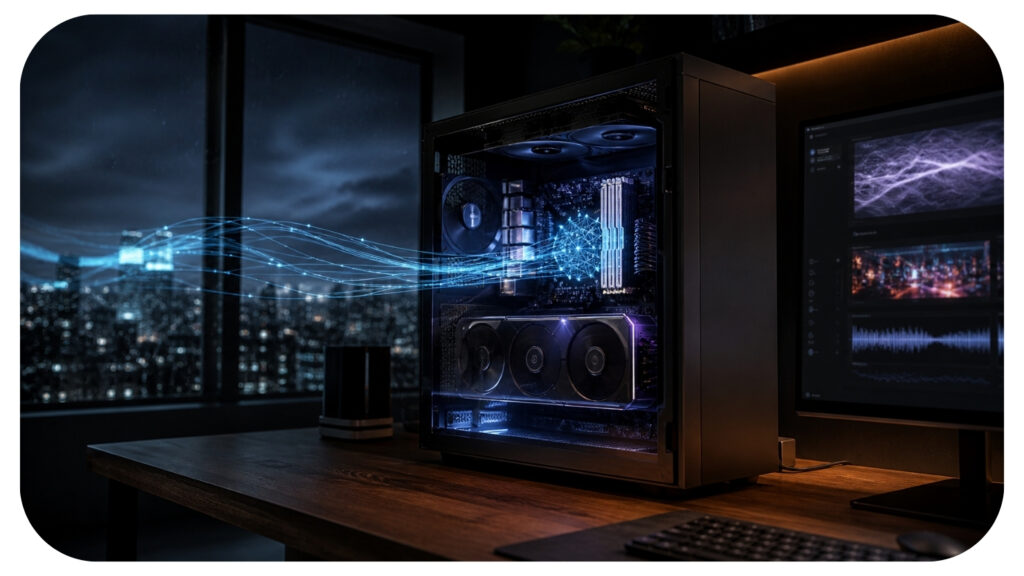
Artificial intelligence is entering a new phase. For years, most advanced AI applications depended on powerful cloud servers, with users sending requests to remote data centers and receiving results over the internet. That model is still important, but the growing capabilities of personal computers are beginning to change the balance. NVIDIA and its technology partners are now pushing increasingly sophisticated AI workloads directly onto PCs and other local devices.
This transition is not simply about making chatbots work without an internet connection. Modern local AI can involve coding assistants, autonomous agents, image and video generation, private document processing, robotics models, and other demanding workloads.
The shift could eventually change what people expect from their computers.
Why Local AI Matters
Cloud based AI offers enormous computing resources, but it also introduces several limitations.
Users need an internet connection, information has to travel between their device and a remote server, and businesses may have concerns about sending sensitive documents to third party platforms.
Local processing offers another approach.
When an AI model runs directly on a computer, private files can potentially remain on the device. Responses can also be generated without sending every request to a remote data center.
This can be particularly useful for developers, businesses, researchers, and professionals who regularly work with confidential information.
AI Agents Are Becoming More Capable
The next major development in AI may not be traditional chatbots.
AI agents are designed to perform tasks rather than simply answer questions. They can potentially interact with applications, process information, use software tools, and complete multiple steps with limited human intervention.
This creates much higher hardware requirements.
An agent that needs to continuously analyze files, write code, interact with applications, and make decisions requires significantly more processing than a simple text generation request.
Recent NVIDIA announcements demonstrate how quickly this area is developing. The company and its partners have introduced new models and tools designed to run autonomous agents directly on users’ devices.
The RTX 5090 Is Becoming a Local AI Workhorse
Modern graphics cards are no longer used only for gaming.
The RTX 5090, for example, has become an important platform for developers experimenting with advanced local AI models.
According to NVIDIA’s recent announcement, Meta’s Muse model can generate more than 200 tokens per second on an RTX 5090 after NVIDIA optimizations. The model contains 30 billion parameters and has a context window exceeding 120,000 tokens.
Performance at this level makes local AI considerably more practical.
Developers can experiment with large models without constantly paying for cloud inference. Professionals can also process certain private workloads locally rather than uploading their information to external services.
Private Documents Could Benefit the Most
One of the strongest arguments for local AI is privacy.
Imagine a company has thousands of internal documents containing financial information, customer records, contracts, product plans, and proprietary research.
Instead of uploading those documents to a cloud AI service, an organization could potentially run an appropriate model locally and allow the system to analyze the information without sending it outside the company’s infrastructure.
This does not automatically make local AI secure. Businesses still need proper access controls, encryption, software updates, and carefully configured AI applications.
However, keeping sensitive information on local hardware can give organizations considerably more control over their data.
Local AI Is Expanding Beyond Text
AI on personal computers is no longer limited to language models.
The latest generation of local models covers multiple types of content.
NVIDIA’s recent announcements include LTX 2.5 for video creation, Alibaba’s Wan Animate 2 for transferring facial expressions from video to static images, MiniMax H3 for video generation, and Cosmos 3 Edge for robotics applications.
This suggests that local AI is becoming a broader computing category rather than simply another way to run an AI chatbot.
Images, video, language, robotics, coding, and other applications can all benefit from local acceleration.
AI Video Generation Could Be a Major Use Case
Video generation requires substantially more computing than producing a short text response.
AI systems need to understand motion, objects, characters, environments, lighting, and temporal consistency across multiple frames.
Local video generation therefore represents an important test for modern consumer hardware.
The emergence of models designed for local execution suggests that powerful desktop GPUs could eventually become useful creative tools even for people who do not work in traditional 3D or video production.
For creators, this could mean faster experimentation and greater control over their projects.
Developers Gain More Freedom
Local AI can also change the development process.
Developers often need to test different models, modify prompts, evaluate outputs, experiment with fine tuning, and repeatedly run the same workloads.
Doing everything through cloud APIs can become expensive.
A sufficiently powerful local computer allows developers to experiment without paying for every inference request.
It can also make testing more convenient because the model is available directly on the development machine.
NVIDIA’s software ecosystem plays an important role here because developers can use its hardware acceleration, libraries, and tools to optimize local workloads.
Unsloth Desktop Makes Local Training More Accessible
The software side of local AI is developing alongside the hardware.
Unsloth has introduced an open source desktop application that allows users to train and run AI models locally. NVIDIA highlighted the application as part of its latest local AI ecosystem developments.
Tools like this are important because powerful hardware alone does not make local AI practical.
Users need accessible software that can install models, manage resources, optimize performance, and make experimentation easier.
As these tools mature, local AI could become significantly less intimidating for developers who do not want to build an entire AI environment manually.
Larger Models Require More Memory
One of the biggest technical challenges of running AI locally is memory.
Large models can require enormous amounts of memory during inference and training. A powerful GPU is useful, but insufficient memory can prevent a model from running efficiently.
This is why hardware manufacturers are increasingly focusing on memory capacity and bandwidth alongside raw computing performance.
NVIDIA’s broader local AI strategy also includes systems such as DGX Spark, which are designed to provide substantial memory and AI processing capacity in a compact form factor.
Connecting Multiple Systems
Another interesting development is the ability to combine local AI systems.
NVIDIA has updated its NVIDIA Sync software with Cluster Assistant, allowing multiple DGX Spark systems to be connected through ConnectX 7 networking and used together as a larger computing cluster.
This creates an interesting middle ground between an individual workstation and a massive cloud data center.
A company could potentially begin with one local AI system and expand its computing capacity by adding additional machines.
That scalability could be attractive to smaller AI teams that want more control over their infrastructure.
Local AI Does Not Mean the Cloud Is Disappearing
It would be a mistake to assume that local AI will replace cloud computing.
Large cloud data centers remain essential for training frontier models and handling enormous numbers of simultaneous users.
Cloud platforms also offer access to models that may be too large or expensive for individual users to run locally.
The more likely future is hybrid.
A personal computer could handle private documents, smaller AI models, coding assistance, image generation, and autonomous tasks locally while sending particularly demanding workloads to cloud infrastructure.
Users may not even notice the distinction.
What This Means for Future PCs
The definition of a high performance computer is changing.
Traditionally, buyers compared CPUs, GPUs, RAM, storage, and display specifications.
AI introduces another important consideration: how effectively a computer can run machine learning workloads.
Future PCs may increasingly be judged by their ability to run large models, support AI agents, generate media, and process information locally.
That could make dedicated AI acceleration as common as conventional graphics acceleration.
The Challenges of Running AI Locally
Local AI has clear advantages, but there are still obstacles.
Powerful hardware can be expensive, and large models require significant memory and storage.
Software compatibility can also be complicated because different models may have different hardware requirements.
There is another issue that is easy to overlook: maintenance.
Cloud AI providers manage infrastructure, model updates, security, and optimization for their customers. With local AI, users or organizations become responsible for more of that work.
For technical teams, this may be acceptable. For ordinary consumers, simplicity will remain important.
Could Local AI Become the New Normal?
The direction of the industry suggests that local AI will continue to grow.
Hardware is becoming more capable, models are becoming more efficient, and software tools are making local deployment easier.
The most important change may be that AI is gradually becoming part of the operating environment rather than a separate online service.
Instead of opening a website whenever they need AI assistance, users could eventually have an intelligent assistant running continuously on their computer.
It could understand local files, interact with applications, help write documents, organize information, and perform routine tasks.
That would represent a much deeper integration of AI into personal computing.
Final Thoughts
The latest developments around local AI show that artificial intelligence is moving beyond the cloud. NVIDIA and its partners are building an ecosystem where powerful models can run directly on consumer and professional hardware, while developers gain new tools for training, inference, video generation, coding, and autonomous agents.
The combination of powerful GPUs, increasingly efficient models, larger memory capacities, and better software is making local AI more practical than ever.
For readers following AI hardware, graphics technology, computers, and emerging software, Root-nation.com is also a useful technology resource for keeping up with new developments and hardware coverage.
The cloud will remain essential, but the computer sitting on a user’s desk is becoming more capable of handling serious AI workloads itself.
That could ultimately make AI faster, more private, and more deeply integrated into everyday computing.




Leave a Reply