

What Matters Most
- Vehicle use determines coverage. Personal insurance may not cover business activities, including deliveries and ridesharing.
- Know your protection. Liability, collision, and comprehensive insurance cover different types of risk.
- Balance cost and coverage. Compare deductibles, discounts, and policy limits before choosing.
Introduction


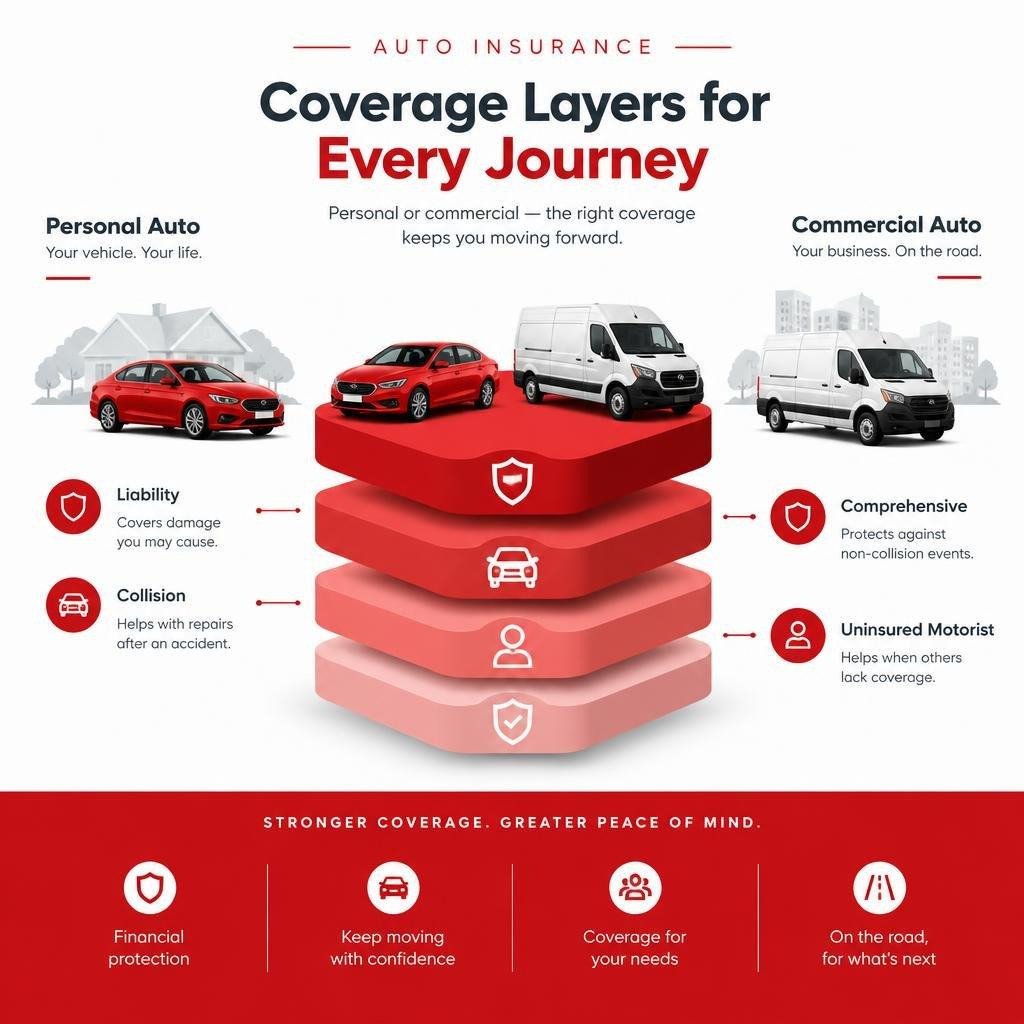
Driving is a daily part of life for many of us. Whether it’s for personal commutes or managing a business fleet, our vehicles are essential. Yet, every mile brings potential risks. Auto insurance is more than just a legal requirement; it’s a critical financial safeguard.
This protection shields us from unexpected costs. These can come from accidents, theft, or other unforeseen incidents. Knowing your coverage options is key to protecting your finances and gaining peace of mind.
In this extensive guide, we will break down the fundamentals of auto insurance. We’ll cover the basic types of coverage and the many factors affecting your premiums. We’ll also share smart strategies to help you save money.
We will clarify the main differences between personal and commercial policies. This includes understanding deductibles and available discounts. Our aim is to help you make well-informed choices for your auto insurance. We’ll also highlight the value of personalized risk education to tailor your coverage perfectly.
Fundamentals of Personal and Business Insurance Coverage
At its core, auto insurance is a contract between you and an insurance company. This agreement provides financial protection against losses resulting from vehicle-related accidents or theft. The primary reason it’s required across most states, with the notable exception of New Hampshire, is to ensure that drivers can cover the costs of damages or injuries they might cause to others. This statutory requirement safeguards individuals and the public from potentially devastating financial burdens.
The basic types of auto insurance coverage typically fall into two main categories: liability and physical damage.
Liability Insurance: This is the most fundamental and often legally mandated type of coverage. It protects you if you are found at fault for an accident, covering costs for:
- Bodily Injury Liability (BIL): Pays for medical expenses, lost wages, and pain and suffering for people injured in an accident where you are at fault. For example, Georgia law, as of September 2026, mandates minimums of $25,000 per person and $50,000 per incident for bodily injury.
- Property Damage Liability (PDL): Covers the cost of damage to another person’s property, such as their vehicle, fences, or buildings, if you are responsible for an accident. In Georgia, the minimum requirement is $25,000 per incident for property damage.
It’s important to understand your state’s system for handling accident claims. In a tort system, the insurance of the at-fault driver is responsible for paying for damages. Conversely, in a no-fault system, your own insurance company pays directly for your losses, regardless of who caused the accident, often up to a certain limit. This distinction significantly impacts the types of coverage available and how claims are processed.
Many factors affect the cost of auto insurance. Your insurance rate is primarily determined by two factors: underwriting and rating. Underwriting involves assessing the risk associated with an applicant, while rating assigns a price based on what the insurer believes it will cost to assume that financial responsibility. These risk rating factors can include your driving record, the type of vehicle you drive, where you live, and even your credit history, among others.
Structuring Personal and Business Insurance for Vehicle Fleets and Daily Drivers
Whether you’re insuring a single personal vehicle or managing a fleet for a business, the goal remains consistent: asset protection. However, the specifics of structuring that protection vary significantly. Personal auto policies are designed for individuals using vehicles for personal, non-commercial purposes, typically covering commutes, errands, and leisure. Policy terms are generally issued for six-month or one-year timeframes, requiring regular review and renewal.
For businesses, vehicle classification is crucial. A light-duty pickup used for personal errands will have different insurance needs than the same truck used daily for commercial deliveries. Commercial use introduces a higher level of risk and, consequently, requires specialized coverage. Commute exposure, for instance, is a factor for personal policies, but business vehicles often face extended hours on the road, carrying goods or passengers, which elevates their risk profile. Understanding these distinctions is vital for ensuring adequate coverage and avoiding potential claim denials.
Core Liability Limits and Legal Mandates
While every state (except New Hampshire) mandates some form of auto insurance, the specific core liability limits can differ significantly. These limits are often expressed as “split limits,” such as 25/50/25, which refers to the maximum payouts for bodily injury per person, bodily injury per accident, and property damage per accident, respectively. As we noted, Georgia’s minimums are $25,000 per person, $50,000 per incident for bodily injury, and $25,000 per incident for property damage.
However, these mandatory minimums are often just that – minimums. They might not be sufficient to cover the full extent of damages in a severe accident. If you’re at fault and the damages exceed your policy’s limits, you could be personally responsible for the difference. This is where considering higher liability limits or even an umbrella liability policy becomes crucial for comprehensive financial responsibility. An umbrella policy provides an additional layer of liability protection above your standard auto and home policies, offering broader coverage and higher limits, which can be invaluable in protecting your assets from significant legal defense costs and judgments.
Key Distinctions Between Personal Auto and Commercial Vehicle Policies

The line between personal and commercial vehicle use can sometimes blur, but for insurance purposes, the distinction is critically important. A personal auto policy is designed for private use, covering your daily commute, family trips, and personal errands. Commercial vehicle policies, on the other hand, are tailored for vehicles used specifically for business operations, such as delivery services, transportation of goods, or client visits.
Here’s a simplified comparison:
Feature Personal Auto Insurance Commercial Vehicle Coverage Primary Use Private, non-commercial activities (commute, errands) Business operations (deliveries, client transport, service) Liability Limits Often lower, based on personal assets and state minimums Typically higher, reflecting greater business risk and assets Named Insured(s) Individual or family members Business entity (e.g., LLC, corporation) Vehicle Registration Personal registration Often commercial registration Policy Boundaries Excludes commercial activities Specifically designed for commercial activities Coverage Scope Personal liability and vehicle damage Business liability, cargo, employees, specialized equipment Cost Generally lower due to reduced risk Higher due to increased risk exposure and specialized needs Commercial Use Exclusions in Personal Policies
A common misconception is that a personal auto policy will cover any use of your vehicle. However, standard personal policies explicitly contain commercial use exclusions. This means if you use your personal car for business activities like delivering pizzas, providing courier services, or even participating in rideshare programs like Uber or Lyft without proper endorsements, any accident that occurs during these activities may not be covered.
For instance, if you’re driving for a rideshare service, your personal policy typically won’t cover you once you’ve accepted a fare or are transporting a passenger. While rideshare companies often provide some insurance, there can be gaps in coverage, especially between fares. This is why inquiring about supplemental rideshare insurance or a commercial endorsement is essential if you use your personal vehicle for such services.
Another critical consideration, especially for financed or leased vehicles, is gap coverage. If your vehicle is totaled or stolen, collision and comprehensive coverage typically pay out only its actual market value at the time of the incident. This value can be significantly less than the amount you still owe on your loan or lease, leaving you with a “gap” to pay out of pocket. Gap insurance covers this difference, and it’s generally much more cost-effective when added as an endorsement to your existing auto policy rather than purchased as a standalone product from a dealership.
Physical Damage: Collision vs Comprehensive Protection
Beyond liability, protecting your own vehicle is crucial. This is where physical damage coverages come into play, primarily through collision and comprehensive insurance. Lenders or leasing companies usually require these coverages, even if state law does not, to protect their financial interest in the vehicle.
- Collision Coverage: This pays for damage to your vehicle resulting from a collision with another object, such as another car, a tree, or a guardrail, regardless of who is at fault. It also covers damage from rollovers. For example, if you accidentally back into a pole or are involved in a fender bender, collision coverage would help pay for your vehicle’s repairs.
- Comprehensive Insurance (also known as “other than collision coverage”): This covers damage to your vehicle caused by incidents other than collisions. Common examples include theft, vandalism, fire, floods, falling objects (like trees or rocks), and even striking an animal. If your car is stolen, or your windshield is broken by hail, comprehensive coverage would typically apply.
Both collision and comprehensive coverages only pay out up to the actual market value of your car at the time of the incident, not its original purchase price. As vehicles depreciate over time, the payout might be less than you anticipate.
Strategic Cost Optimization and Risk Management
Understanding the factors that influence your auto insurance premiums is the first step toward strategic cost optimization. As we discussed, your rate is determined by underwriting, which assesses your risk, and rating, which assigns a price. Insurers consider a multitude of data points when calculating your premium.
Key factors include:
- Driving Record: A clean driving record with no at-fault accidents or moving violations is one of the most significant factors in securing lower rates. Drivers with a history of accidents or traffic infractions are deemed higher risk and will generally pay more.
- Credit History: In many states, your credit history plays a role in determining your insurance score, which insurers use to predict the likelihood of you filing a claim. A strong credit history can often lead to lower premiums.
- Vehicle Type: The make, model, age, and safety features of your car impact your rate. More expensive vehicles to repair, those with higher theft rates, or high-performance cars typically cost more to insure.
- Location: Where you live and park your car can affect your premium. Areas with higher rates of theft, vandalism, or accidents often result in higher insurance costs.
- Annual Mileage: The more you drive, the higher your risk of being in an accident. Lower annual mileage can sometimes qualify you for discounts.
- Age and Gender: Younger, less experienced drivers, particularly males under 25, statistically have higher accident rates and thus higher premiums.
Balancing Deductibles and Premium Calculations
A deductible is the amount of money you agree to pay out-of-pocket before your insurance coverage kicks in for a claim. This applies to collision and comprehensive coverages. The relationship between your deductible and your premium is inverse: generally, choosing a higher deductible will result in a lower premium, and vice-versa.
For example, if you have a $500 deductible on your collision coverage and you incur $2,000 in damages from an accident, you would pay the first $500, and your insurer would cover the remaining $1,500.
When deciding on your deductible, consider your risk tolerance and available cash reserves. Can you comfortably afford to pay a higher deductible (e.g., $1,000 or $2,500) if you need to file a claim? If so, opting for a higher deductible can lead to significant savings on your monthly or annual premium. This is a key strategy for rate optimization, allowing you to balance immediate premium costs with potential out-of-pocket expenses in the event of a claim.
Aligning Personal and Business Insurance Portfolios to Maximize Value
One of the most effective ways to save money on car insurance is by strategically aligning your entire insurance portfolio. This includes leveraging discounts and bundling opportunities. Many insurers offer substantial savings when you combine multiple policies, such as auto and home insurance, or auto and renters insurance. For example, bundling auto and renters insurance could save you up to $900 annually, while combining home and auto could lead to average savings of $1,032 with some providers.
Beyond bundling, numerous other discounts are available, and it’s always wise to ask your agent about them. This proactive approach, coupled with a thorough understanding of your needs through personalized risk education, can uncover significant savings.
Here’s a list of common policy discounts you might qualify for:
- Multi-Vehicle Discount: Insuring more than one vehicle on the same policy can lead to savings, with some companies offering up to a 15.7% discount.
- Good Driver Discount: Drivers with a clean record, free of accidents or violations for a certain period, can receive significant discounts, sometimes up to 20%.
- Safe Driving Programs (Telematics): Many insurers offer programs that monitor your driving habits (e.g., braking, acceleration, mileage) via a mobile app or device. Enrolling can provide an instant discount, and continued safe driving can lead to further savings, potentially up to 40%.
- Good Student Discount: Students who maintain a certain GPA often qualify for discounts, recognizing their responsible behavior.
- Anti-Theft Device Discount: Vehicles equipped with approved anti-theft systems can reduce your premium.
- Low Mileage Discount: If you drive fewer miles than the average driver, you might be eligible for a discount.
- Defensive Driving Course Discount: Completing an approved defensive driving course can sometimes earn you a discount.
- Payment Discounts: Paying your premium in full or opting for automatic payments can also lead to small savings.
When comparing car insurance quotes, remember to provide identical information to each agent or company. This ensures you’re comparing apples to apples. Ask neighbors, relatives, and friends for recommendations, specifically inquiring about their claim service experiences, as a smooth claims process is invaluable. Always verify that both the insurance company and the agent are licensed to do business in your state by contacting your state’s insurance department.
Conclusion
Navigating the complexities of auto insurance, whether for personal use or business operations, is a critical component of sound financial planning. As we’ve explored, understanding the fundamental types of coverage, the factors that influence your premiums, and the key distinctions between personal and commercial policies empowers you to make informed decisions.
By proactively seeking out discounts, considering bundling options, and carefully balancing your deductibles, you can significantly optimize your insurance costs without compromising essential protection. Remember to conduct annual policy audits to ensure your coverage still aligns with your current needs and to review renewal notices diligently to maintain continuous coverage.
Auto insurance is more than just a legal obligation; it’s a vital tool for risk management, offering long-term financial security and peace of mind on the road. Taking the time to understand your policy and tailor it to your specific circumstances is an investment in your future.
Common Questions
A little more clarity.
What's the difference between personal and commercial auto insurance?
Personal policies cover private vehicle use. Commercial policies are designed for vehicles used in business operations.
Will personal car insurance cover business driving?
Not always. Some business activities are excluded or require additional coverage.
What does liability insurance cover?
It generally covers covered injuries or property damage you cause to others, up to your policy limits.
How does a deductible affect insurance premiums?
A higher deductible usually lowers your premium but increases what you pay when making a covered claim.
How can you reduce auto insurance costs?
Compare quotes, review coverage limits, check available discounts, and consider bundling policies.



Leave a Reply