

What Matters Most
- Measure the delivery route. A pool that fits your yard may not fit through its gates or narrow passages.
- Plan beyond shell delivery. Cranes, excavation, utilities, drainage, and finishing work can affect cost and timing.
- Compare the full project. Fiberglass and concrete pools have different installation requirements, so assess both against your property's conditions.
Your backyard looks big enough. There’s space for a swimming pool, a few lounge chairs, and perhaps a patio beside the water.
You’ve even found a fiberglass pool with the right dimensions.
Then the installer asks a question you hadn’t considered: How are we getting it into the yard?
Unlike concrete pools built on-site, fiberglass swimming pools arrive as prefabricated shells. This can reduce some construction work, but getting a large, one-piece structure from the delivery truck to the excavation requires careful planning.
Fences, narrow passages, overhead cables, trees, and neighboring buildings can all complicate installation.
Before committing to a pool model, ask your installer for a written access assessment showing how the shell will reach its final position.
The Backyard Has Enough Space, but What About the Route?
A swimming pool may fit comfortably within the property boundaries while being difficult or impossible to deliver through the available access.
The important measurement isn’t just the pool’s footprint. It’s the entire route from the street to the excavation.
A Narrow Side Gate Can Change the Installation Plan
Consider a backyard located behind a garage.
There’s enough room for the selected fiberglass pool, but the only ground-level access is a narrow passage beside the house.
The installer must check whether the shell can pass through the opening and navigate any turns without damaging surrounding structures.
Removing a fence panel might help, but air-conditioning units, roof overhangs, retaining walls, trees, and neighboring properties can still obstruct the route.
Ask the installer to document:
- The narrowest available width.
- The lowest overhead clearance.
- The tightest turns along the route.
- The proposed truck unloading location.
- Any structures or landscaping requiring temporary removal.
These measurements should be checked against the selected pool’s actual transport dimensions and the equipment required for delivery.
Ground-level access, temporary fence removal, and crane placement should be compared before the installation quote is finalized.
A Crane May Solve One Problem and Introduce Another
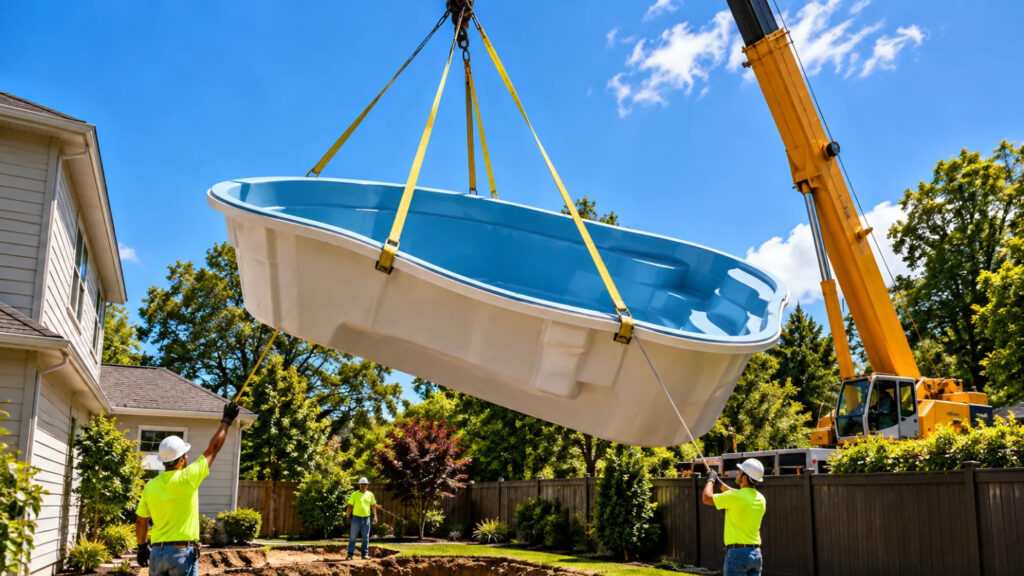
When a fiberglass shell cannot reach the backyard at ground level, contractors may consider lifting it over the house with a crane.
That sounds straightforward, but a safe lift requires much more than finding a crane tall enough.
The contractor must consider the shell’s weight, the lift radius, suitable crane positioning, ground conditions, available space for outriggers, and possible obstructions.
The farther a load must travel from the crane’s position, the more carefully its lifting capacity must be evaluated.
Overhead power lines are particularly important.
The Occupational Safety and Health Administration identifies electrical contact as a serious construction hazard.
OSHA’s construction crane requirements also address the assessment of nearby power lines and the protective measures employers must take during covered lifting operations.
A qualified crane professional should evaluate the proposed lift, including site conditions and applicable safety requirements.
If neither ground access nor a safely planned crane lift is practical, the homeowner may need to consider a smaller fiberglass model or a pool constructed on-site.
One-Piece Delivery Doesn’t Mean One-Day Installation
Fiberglass pools are manufactured before reaching the property, so the shell itself doesn’t need to be built in the backyard.
That’s an advantage, but it doesn’t mean the entire project is completed when the shell arrives.
The Excavation Must Be Ready Before the Shell Arrives
Excavation should be planned around the selected pool model’s dimensions and installation requirements.
Before work begins, request the manufacturer’s installation instructions, technical specifications, and warranty conditions.
These documents help the installer determine excavation tolerances, base preparation, plumbing requirements, and the correct installation sequence.
Once the shell is lowered, crews must verify its position and level while completing backfilling and water filling according to the manufacturer’s specifications.
Improper preparation, leveling, or backfilling can create structural and finishing problems that may be expensive to correct.
The Surrounding Yard Still Needs Work
After the shell is positioned, contractors must address plumbing, electrical connections, drainage, equipment installation, decking, and landscaping.
A homeowner may see the pool lowered into place in a single day and assume the project is almost complete.
In reality, inspections, weather, site conditions, utility work, and finishing stages can affect the schedule.
The surrounding landscaping also needs consideration, particularly if fences, irrigation systems, lawns, or garden features must be removed during construction.
Ask for a schedule that separates excavation, shell placement, equipment connections, inspections, and the date the pool is expected to be ready for use.
A quick shell installation should not be confused with a finished swimming pool.
Concrete Pools Avoid the One-Piece Delivery Challenge
Concrete pools are constructed at the property instead of arriving as completed shells.
This removes the need to maneuver a large prefabricated pool through the backyard, but it introduces a different set of construction requirements.
Building On-Site Allows More Design Flexibility
Concrete pools typically use reinforced concrete structures, often formed using gunite or shotcrete.
Because the pool is built on-site, the design can accommodate unusual dimensions, custom depths, curved boundaries, and features that may not be available in standard fiberglass models.
This flexibility can be valuable for irregularly shaped properties or homeowners planning highly customized outdoor spaces.
Construction Equipment Still Needs Access
Building a concrete pool doesn’t eliminate access challenges.
Excavators, soil-removal equipment, concrete delivery systems, and construction crews still need appropriate access to the site.
Narrow passages can increase labor requirements, complicate material handling, and affect the project schedule.
Concrete pools also involve additional construction, curing, and finishing stages.
For a restricted backyard, ask the contractor how excavated soil will be removed and how construction materials will reach the work area without damaging existing structures.
The better option is the one that can be installed safely and economically on the actual property.
What Lies Beneath the Backyard Matters Just as Much
A relatively level lawn can hide conditions that complicate either type of pool installation.
Underground utilities, unstable soil, groundwater, and drainage problems may not become apparent until the site is properly assessed.
Underground Utilities Must Be Located Before Excavation
Gas lines, electrical cables, water services, and drainage pipes may cross the proposed pool location.
In the United States, homeowners and contractors should use the 811 notification system before digging, following applicable state requirements.
The notification allows participating utility operators to arrange marking of covered underground facilities.
However, not every private utility line is necessarily identified through the 811 process. Privately installed electrical wiring, irrigation lines, or other services may require separate locating arrangements.
Before excavation, confirm who is responsible for utility notifications, private-line investigations, and resolving conflicts with the proposed pool location.
Discovering a utility line after excavation begins can lead to delays, additional costs, or a change in design.
Sloping Ground and Drainage Can Alter the Design
A sloping backyard may require grading, retaining structures, or drainage improvements before a pool can be installed.
Soil conditions and groundwater levels can also influence excavation methods, structural requirements, and long-term stability.
For fiberglass pools, groundwater management is particularly important because the shell and surrounding ground must be evaluated for conditions that could affect structural performance.
A professional site assessment can help determine whether additional engineering or drainage work is needed.
These findings should inform the pool selection and preliminary budget, not emerge as unexpected complications after the contract is signed.
The Pool Material Affects More Than Installation
Even when delivery access is straightforward, fiberglass and concrete pools have different characteristics that matter throughout ownership.
Fiberglass manufacturers offer established shapes and sizes, often with integrated steps, benches, or seating areas.
Concrete provides greater freedom over layout and design, but generally requires more extensive on-site construction.
Homeowners may encounter the claim that Fiber glass swimming pools are better, but the right choice depends on the property, construction requirements, maintenance expectations, and budget.
A Smooth Surface Doesn’t Eliminate Maintenance
Fiberglass pools typically have smooth, relatively nonporous gel-coat finishes that can make routine surface cleaning easier.
Concrete pools may have plaster or other cement-based finishes that require different maintenance practices and eventual resurfacing.
However, both pool types need regular water testing, appropriate chemical treatment, filtration, cleaning, and equipment maintenance.
Neither material eliminates the responsibility of maintaining safe, sanitary pool water.
When comparing options, consider not only the initial installation but also the type of maintenance each surface requires over time.
The Lowest Pool Quote May Not Cover the Entire Backyard Project
A pool quotation can look attractive until additional construction requirements are included.
To compare fiberglass and concrete options fairly, ask contractors to price the same overall project scope.
That should include the pool structure, excavation, soil removal, access arrangements, utilities, permits, inspections, decking, barriers, and restoration work.
Any excluded or uncertain costs should be clearly identified.
Access Restrictions Can Add Unexpected Costs
Restricted access may require cranes, specialized excavation equipment, temporary fence removal, traffic management, or changes to the delivery route.
These costs should appear in the written estimate rather than being left for discussion after work begins.
Ask whether lifting and site-access costs are fixed, provisional, or charged separately.
Also confirm who is responsible for repairing damaged driveways, irrigation systems, fences, lawns, and other existing features.
Written approval should be required before additional chargeable work proceeds.
The Budget Should Include Safety and Long-Term Ownership
A swimming pool is more than a shell filled with water.
The full project may require fencing, gates, drainage improvements, safe equipment access, and ongoing maintenance.
The U.S. Consumer Product Safety Commission recommends protective measures such as pool barriers and self-closing, self-latching gates to help reduce drowning risks.
Applicable fencing, setback, permit, and inspection requirements vary by location, so homeowners should confirm the rules with their local building department.
The International Swimming Pool and Spa Code is a model code that jurisdictions may adopt or modify. It should not be treated as a uniform nationwide requirement.
A realistic budget covers the complete, safely usable pool area, not just the cost of the fiberglass shell or concrete structure.
What to Ask Before Signing the Installation Contract
Before placing a nonrefundable order or signing a final installation agreement, request a written site-access assessment tied to the selected pool and excavation location.
Ask the contractor to confirm:
- Delivery access: What route will the pool and equipment take, and which measurements have been verified?
- Crane requirements: Is a crane necessary, who will assess the lift, and who pays for it?
- Underground utilities: Who handles 811 notifications, private utility locating, and any required relocation?
- Ground conditions: Have drainage, groundwater, slope, and soil conditions been evaluated?
- Permits and safety: Who obtains approvals and arranges required inspections and barriers?
- Total costs: Which items are fixed-price, excluded, or provisional?
- Restoration: Who repairs landscaping, fences, driveways, and other affected areas?
Ask for the site-access plan, itemized scope, and relevant exclusions to be included in the contract.
That makes competing quotations easier to compare and reduces uncertainty if unexpected work becomes necessary.
Choose the Pool That Works With the Property
Fiberglass pools can simplify part of the construction process when the selected shell fits the site and can be delivered safely.
Concrete pools may offer greater flexibility when a backyard has unusual dimensions or a one-piece shell cannot be installed practically.
Neither option is automatically the better investment.
The important decision is whether the pool, delivery method, ground conditions, and total construction costs work together.
Before choosing the design that looks best in a brochure, make sure it can be built properly in the backyard you actually have.
Sources
- OSHA: Power Line Safety for Construction Cranes (opens in a new tab)Safety requirements for construction cranes operating near power lines, including work-zone assessments and necessary precautions.
- PHMSA: Call Before You Dig (opens in a new tab)Underground utility locating, 811 notifications, and excavation-damage prevention before digging.


Leave a Reply