

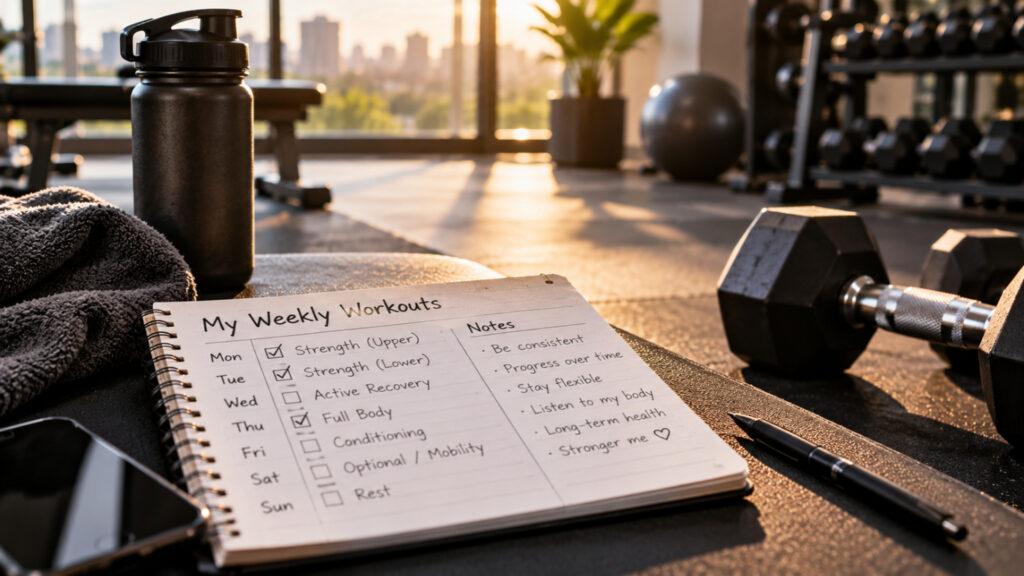
What Matters Most
- Keep it realistic. Plan workouts around your actual schedule, not an ideal week.
- Have a backup plan. A shorter workout can keep you consistent when life gets busy.
- Make recovery part of progress. Balance hard and easy days, and adjust your effort when needed.
Most people don’t fail at fitness because they lack a good program. They fail because their weekly schedule can’t survive a bad week. The solution is not to become more inspired but to create a framework that can endure some disorganization without breaking down.
Treat training frequency as a scheduling problem
What matters is not the number of days you train a week but that you train on those days. Many people follow a “perfect” five-day split but miss three workouts a week because life interferes. Three full-body workouts that you consistently complete will build fitness faster than four upper/lower sessions that only exist theoretically.
Decide on a number based on your real life, not your fantasy one. If you can realistically ring-fence three slots per week, base on three. If you’re likely to miss two workout times because of overtime, base on three, and try for more sessions when work isn’t as crazy. Input the days into your week as specifically as a dentist appointment – not “whenever I can make it”, an exact time and day that you can block out for the rest of the year.
Know when to bring in outside eyes
Picking a realistic number of sessions is much easier when someone is looking at your actual week alongside you. Working with online fitness coach Andy Griffiths isn’t about handing over control. It’s about getting a plan written around your baseline, your constraints, and your recovery, rather than a template written for nobody in particular.
A generic weekly template is a sensible enough starting point for most people, but work schedules, injury history, and recovery capacity vary enough that it often needs adjusting sooner than you think. A proper fitness assessment at the start also gives the plan some real heft. Knowing your actual baseline – strength levels, conditioning, movement patterns – makes the weekly structure feel like it’s actually tugging you towards something specific, rather than just filling slots in your calendar.
Build a minimum viable version of every session
Always have a plan to fall back on. If you’re having a tough day, you’re not skipping that session, you’re doing the 20-minute version: two compound lifts and a short finisher. End of story. Decide what that version looks like in advance, such as squats and presses followed by five minutes on the bike, so there’s no thinking required when you’re tired. The fewer decisions you have to make on a bad day, the more likely you are to turn up.
This isn’t cheating. It’s what keeps the habit alive when the tank is running low or life gets in the way. Miss one session and you’re more likely to miss the next, and two missed sessions can quickly turn into a lost fortnight. A short workout keeps the routine intact, and you’ll often find that once you’ve started, you feel up to doing a little more than planned. Shorten your sessions if you must, but treat them as sacred.
Alternate hard and easy, not hard and harder
A schedule for the week that increases in difficulty may lead to missing a workout, as fatigue will not have decreased. Thus, it is more appropriate to schedule a demanding workout, followed by one lighter in intensity. Then, you can have another demanding workout, and finally take a rest. This pattern will not allow fatigue to build to a level high enough that your body refuses to exercise.
Rest days are not arbitrarily included in the schedule – on the contrary. Proper recovery is what will make your next workout challenging. Often, individuals tend to “squeeze” a missed workout into a recovery day, thus boiling down to two missed workout sessions.
Apply progressive overload flexibly, not rigidly
Gradually making your workouts more challenging is the key to progress, but it should be done wisely. If you’re tired or not feeling well, just keeping the same level as last time is progress. Conversely, pushing yourself to the limit every single workout is a recipe for disaster, both mentally and physically. This concept, known as auto regulation, is about adjusting your effort based on how you feel rather than external goals.
A simple way to put this into practice is to leave a rep or two in reserve on most sets, stopping when you feel you could have done one or two more with good form. On days when the weights move well, add a little load or an extra rep; on days when everything feels heavy, hold steady or trim a set. Over a few months, those small, honest adjustments add up to far more progress than forcing a number onto the bar because the plan said so, and they keep you fresh enough to actually turn up for the next session.
Plan a deload before you need one
A sustainable training regimen must include a well-thought-out off-ramp. Roughly every month to six weeks, you’ll have to reduce volume or intensity for a scheduled week. It will look like a decrease in performance, but knowing when to pull back and simplify is one of the keys to a longer, more consistent lifting career.
A deload week also resets motivation. It gives you a natural point to review what’s worked, adjust the split, and head into the next block with a plan instead of guesswork.
Give it longer than you think
Building a training habit takes longer than most people expect, often a few months rather than a few weeks before it starts to feel automatic. Early on, every session can feel like a negotiation with yourself, especially when work runs late or energy is low. That’s normal, and it doesn’t mean the plan is failing. It means you’re still in the stage where it takes deliberate effort.
So don’t judge your new routine on a couple of rough weeks. A schedule with built-in recovery, a realistic number of sessions, and a minimum viable fallback is designed for real life, where bad weeks are a regular feature rather than a rare exception. Stick with it long enough, and training stops being something you have to talk yourself into and becomes something you just do.
Common Questions
A little more clarity.
How many days a week should I work out?
Choose a number you can realistically maintain. Three consistent workouts may be more useful than an ambitious five-day plan you rarely complete.
What if I only have 20 minutes to exercise?
Do a shorter session with a couple of key exercises and a quick finisher. It helps keep your routine going.
Should I work out every day?
Not necessarily. Include lighter sessions and recovery days so your body has time to recover between demanding workouts.
What should I do when I'm too tired for my usual workout?
Reduce the weight, repetitions, or number of sets. You don't need to push harder every session to make progress.




Leave a Reply