

What Matters Most
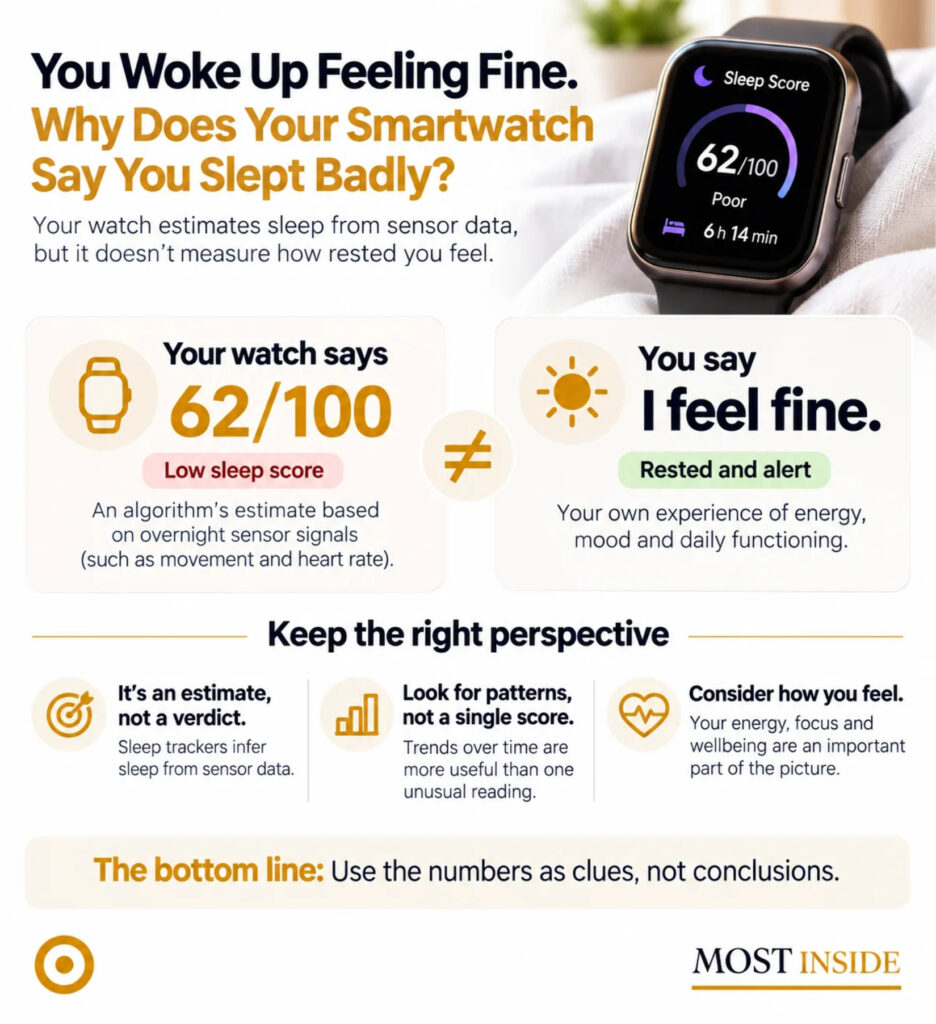
- Your sleep score is an estimate, not a medical verdict. Wearables calculate sleep information from signals such as movement and heart rate.
- Your watch and your body measure different things. You may feel refreshed even when your device reports restless or poor sleep.
- Look for patterns, not perfection. Repeated changes in sleep, daytime symptoms and how you function matter more than a single score.
Your questions, answered.
A little more clarity.
How Can Your Watch Say You Slept Badly When You Feel Completely Fine?
Because your watch doesn’t directly measure how rested you feel.
It estimates sleep using sensor data and software algorithms. Your own assessment includes things the watch cannot fully capture, such as your energy, mood and alertness after waking.
A 2026 systematic review of five studies involving 2,006 adults found that wearable measurements had poor-to-moderate agreement with people’s reported sleep quality.
Your sleep score and your experience can disagree without either telling the whole story.
What Does a Smartwatch Actually Measure While You're Sleeping?
Most consumer sleep trackers use movement and signals such as heart rate to estimate when you’re asleep, when you’re awake and how your sleep changes overnight.
Some devices also use temperature or other sensor data.
The watch then applies an algorithm to generate sleep stages, duration estimates and, on some products, an overall score.
But it generally doesn’t measure brain activity the way a clinical sleep study does.
Your watch measures signals and estimates sleep. It doesn’t observe sleep directly in the same way as a sleep laboratory.
Can Your Watch Get Deep Sleep or REM Sleep Wrong?
Yes. Estimates of individual sleep stages can be inaccurate.
Deep sleep and REM sleep are important stages, but consumer trackers infer them from indirect measurements.
Research comparing wearables with polysomnography, a clinical sleep study, has found variation in sleep-stage accuracy across devices.
If your watch reports unusually little deep sleep one night, that alone doesn’t prove you experienced a medical sleep problem.
Treat individual sleep-stage numbers as estimates, not exact measurements.
Is Your Sleep Score More Important Than How You Feel?
Neither should be considered in isolation.
A wearable may help you notice changes in bedtime, sleep duration or overnight patterns. How you feel during the day provides another important piece of information.
For example, one low score followed by a normal, energetic day may be less concerning than persistent exhaustion despite apparently good sleep scores.
Does your sleep tracker ever disagree with how you feel?
Equally, feeling fine doesn’t rule out every sleep disorder.
The useful question isn’t simply, “Was my score good?” It’s, “Am I sleeping consistently and functioning well?”
When Should You Pay Attention to a Low Sleep Score?
Pay more attention when changes continue over time or occur alongside symptoms.
Consider whether you’re regularly sleeping too little, waking frequently, struggling with daytime sleepiness or noticing a significant change in your usual sleep pattern.
A sleep diary can help you compare your device estimates with your actual bedtime, waking time and how rested you feel.
Persistent symptoms deserve medical attention, regardless of whether your watch reports a good or bad score.
Loud habitual snoring, witnessed breathing pauses or significant daytime sleepiness are reasons to discuss possible sleep problems with a healthcare professional.
What's the Smarter Way to Use Your Sleep Tracker?
Use it to learn about your habits, not to chase a perfect nightly score.
For the next week, compare three things:
- Your sleep schedule: When did you go to bed and wake up?
- Your daytime experience: Did you feel rested, alert and able to function?
- Your device estimates: Are there consistent patterns rather than isolated unusual readings?
Over time, these observations may help you identify changes worth discussing with a healthcare professional.
A sleep tracker can be useful without being perfectly accurate.
One Last Question
Are you using your smartwatch to understand your sleep, or letting its score decide how you feel about your night?
Your device can give you useful information. Your lived experience matters too.
Use the numbers as clues, not conclusions.
Sources
- Sleep Medicine: Concordance of Wearable Device Sleep Metrics With Patient-Reported Sleep Quality (2026) (opens in a new tab)Supports Questions 1 and 4. A systematic review of five studies involving 2,006 adults found poor-to-moderate agreement between wearable sleep measurements and self-reported sleep quality.
- American Academy of Sleep Medicine: Consumer Sleep Technology Position Statement (opens in a new tab)Supports Questions 2, 3 and 5. Explains the limitations of consumer sleep tracking and why wearable data should not replace clinical evaluation for sleep disorders.
Was this helpful?
What could be better? (optional)



Leave a Reply