

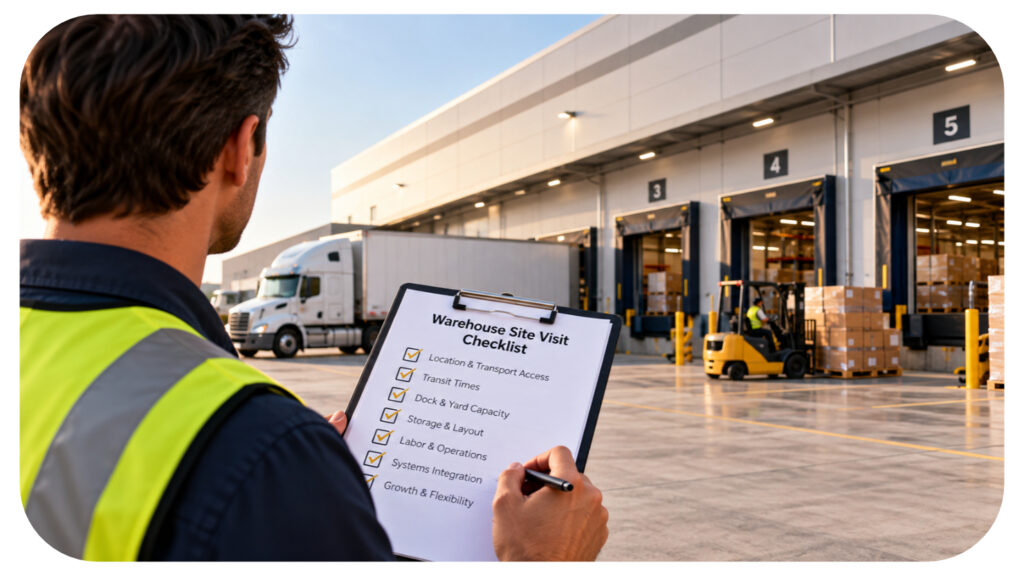
Photos make every warehouse look good. A site visit helps you assess whether a third-party warehouse location fits your orders and delivery requirements. Use the tour to test the location against the lanes and volumes you expect it to handle.
Map inbound and outbound lanes first
Don’t walk into a tour without numbers. Bring your SKU count and monthly order volume. List storage needs by pallet type and velocity. Buyers can fall for a clean building that can’t hold their product mix or meet their ship dates.
Map your inbound supply points and your outbound customer clusters before you leave. That map is more useful than any brochure because it shows where your freight already moves. A site that looks central on paper can still miss your heaviest lanes and push freight rates up enough to wipe out any rent savings.
Check how each candidate fits your distribution network and transportation infrastructure. Look for direct highway access and intermodal options that match your inbound and outbound moves. If you import or export, ask about port access and drayage time from gate to dock. Customer geography matters far more than closeness to your own office, so rank sites by proximity to buyers and suppliers rather than drive time from headquarters.
Validate transit times to your customers
Ask for transit times to your top ZIP codes, not just regional averages. A provider can claim two-day coverage while your best customers sit at the edge of that promise. Get those transit times in writing by lane and mode, then compare them to your target delivery windows.
Do your own drive-time check on the way in. Note congestion and road limits that could affect truck access. Check last-mile distance to dense buyer areas. There’s no substitute for seeing how trucks actually enter and exit at peak hours.
Many teams start with a search for “3PL warehouse near me” and end up with a long list of options that all look close. Use lane-specific transit and cost information to build a shortlist, then confirm each site’s capabilities on the visit.
Walk the building for flow, not square footage
Square footage alone tells you little.
Start outside. Watch dock doors during a live unload and count trailers in the yard. You want enough doors and staging space for your daily truck count plus a surge week, without double parking or waiting on the street. Ask about truck routes and hours of operation, since zoning and permits can limit night moves or idle time.
Inside, follow an order from rack to load. Look at floor condition and column spacing first, because cracks and tight grids slow forklifts and waste slots. Then check clear ceiling height and whether the racking systems suit your SKU sizes and pick methods. A good warehouse layout keeps fast movers near pack stations and keeps replenishment out of the pick path.
Ask about lease flexibility in plain terms. You need to know how long the 3PL controls the space and what happens if you need more slots or less space next year. Even a well-placed site loses much of its value if the provider can’t stay there or grow there.
Check labor and daily operations
Ask who actually picks your orders. A deep labor pool helps, but a logistics-heavy area can mean stiff competition for trained staff. Ask about shift coverage and how the site fills weekends and peak overtime.
Talk through hours and pick accuracy with the warehouse manager. Then ask about staff turnover separately, since high churn often shows up first as mispicks and late loads. You can’t fix service if the site can’t keep trained people.
Tour during normal shift hours and watch a full pick cycle. Request a small proof-of-concept run on your own SKUs if you can, even if it’s just inbound receipt plus ten outbound orders. Ask to see the tenant mix and where your product would sit, because a building that is close to full gets tight fast when two clients peak at once.
Go over integration timelines and switching costs with the operations team rather than leaving those questions to sales. You need a clear plan for systems links and label testing. Cover EDI checks and inventory transfer in the same walkthrough. Ask how the site would keep shipping if one inbound load runs late or one carrier misses a pull time, so you leave knowing how it would meet target delivery windows under stress, not just on a quiet Tuesday.
Turn notes into a scorecard and follow-up
Score every site on the same sheet before memory fades. Rate lanes alongside transit times. Assess whether the docks and yard can handle your volumes. Rate storage and flow plus labor and supervision. Add notes and photos from each stop so comparisons stay honest.
Follow up within a day with open items and owners. Ask for missing transit documentation and a written plan for peak throughput. Ask for references in similar categories. A building’s appearance tells you little about how well it will serve your orders. Choose the location that moves your freight to your customers day after day without drama.




Leave a Reply